
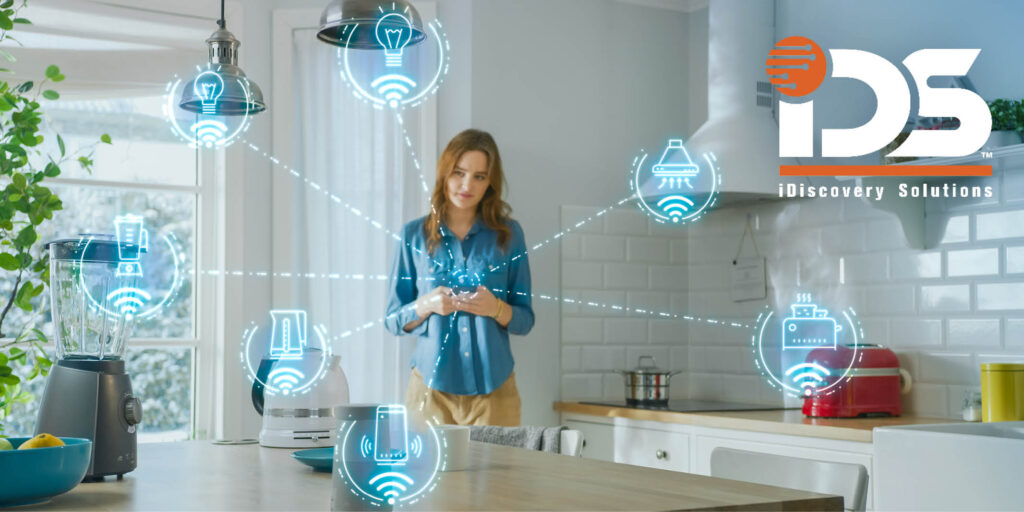
Your fitness tracker knows how far you walked yesterday. Your car knows how hard you braked last Tuesday. Your smart thermostat knows when you came home. Your factory floor sensors know whether a component met spec before it shipped.
None of them will forget. And increasingly, courts are asking them to testify.
In the fifth installment of the Concernant les preuves colonne dans Associé gérant d'aujourd'hui, PDG et fondateur d'iDS Dan Regard examines how the Internet of Things — and its industrial counterpart, the IIoT — has quietly become one of the most consequential new sources of evidence in modern litigation.
The Scale of the Opportunity
The numbers alone are striking. Connected IoT devices worldwide surpassed 13 billion in 2022 and are projected to exceed 40 billion by 2034. Every one of those devices is a potential silent witness — recording movements, conditions, decisions, and events with a consistency and granularity that no human witness can match.
The legal implications are already playing out in courtrooms. In a 2017 Connecticut murder case, Fitbit data contradicted a suspect’s account of when the victim died. Vehicle telematics have refuted driver claims in accident cases, showing acceleration patterns that directly contradicted testimony. Smart ID badges have verified or challenged employee presence in wrongful termination disputes. IIoT sensor logs from a factory floor exonerated a manufacturer by demonstrating that faulty components had been subjected to out-of-spec conditions after they left the facility.
In each case, the data didn’t argue. It simply recorded.
The Challenges Legal Teams Need to Understand
Regard is careful to note that IoT evidence comes with its own set of challenges — and legal teams that understand them early will be far better positioned.
Data retention is perhaps the most pressing. Many IoT devices continuously overwrite old data to make room for new recordings. If preservation isn’t triggered early, critical evidence can be permanently lost before litigation even begins. This challenge intensifies with edge computing — where devices don’t just sense but process and decide locally — creating high-volume, short-lived data footprints that are often impossible to collect after the fact.
Authenticity is the other major battleground. Just as Regard explored in the previous article in this series, proof of origin matters here too. Courts may require cryptographic verification to establish that IoT records are genuine and unmodified — a layer of forensic work that demands early expert involvement.
A Practical Framework for Attorneys
For legal teams navigating IoT evidence, Regard offers a four-stage checklist covering identification of relevant data sources, admissibility considerations, evaluation of claims, and litigation strategy. The framework addresses everything from time synchronisation across devices to educating the court in plain language — a reminder that even the most compelling IoT evidence needs to be translated into something a judge or jury can follow.
The bottom line, as Regard frames it: the question for litigators is no longer if IoT evidence will be critical — it is whether they are ready to use it to their advantage.
At iDS, that readiness is built into how we approach every engagement. Our Médecine légale numérique, Données structurées et analyses, et Témoignage practices are equipped to identify, preserve, interpret, and present IoT and IIoT evidence in a way that holds up under the most demanding scrutiny.
Pour contacter un expert iDS, rendez-vous sur idsinc.com.
iDS fournit des solutions de données consultatives aux entreprises et aux cabinets d'avocats du monde entier, leur donnant un avantage décisif, tant dans la salle d'audience qu'en dehors. Les experts en la matière et les stratèges de données d'iDS se spécialisent dans la recherche de solutions à des problèmes de données complexes, garantissant que les données peuvent être exploitées comme un atout et non comme un handicap. Pour en savoir plus, visitez idsinc.com.
Vous avez des difficultés avec un terme technique utilisé dans cet article ? Consultez notre… Glossaire des analystes de données décrypter le code.